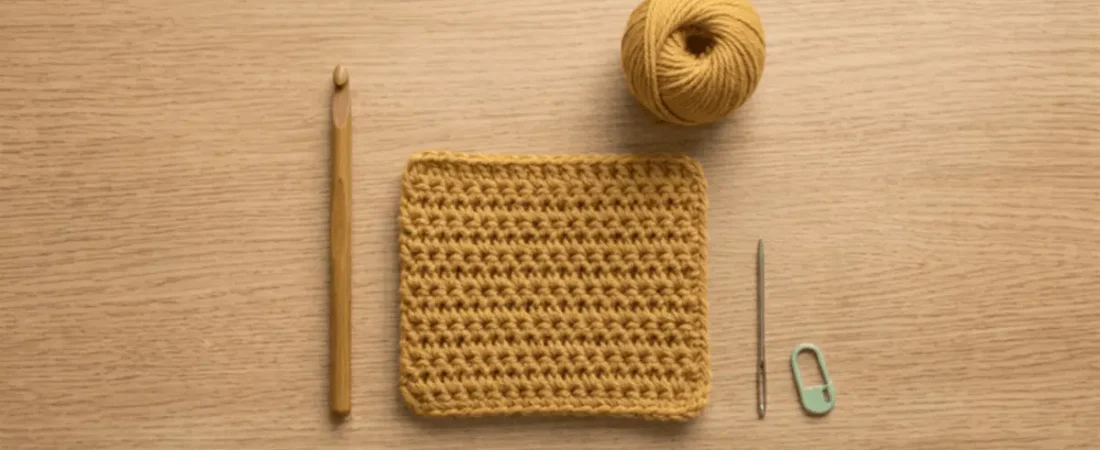
To do a slip stitch in crochet, insert your hook into the next stitch, yarn over, and pull the yarn through both the stitch and the loop on your hook in one motion. It’s abbreviated sl st, it’s the shortest crochet stitch and it adds almost no height.
The slip stitch is small, but you’ll use it in almost every crochet pattern. It joins rounds, moves your yarn across a row, closes seams and finishes edges.
This guide shows you how to do a slip stitch in crochet, how to join a round neatly, whether the slip stitch counts as a stitch and how to keep it from getting too tight.
Key takeaways
- A slip stitch is the shortest crochet stitch. It adds almost no height.
- Three steps: insert, yarn over, pull through the stitch and the loop on the hook.
- It’s abbreviated sl st (and ss in many UK patterns).
- A joining slip stitch usually doesn’t count as a stitch. A row of slip stitches does. Check your pattern’s notes.
- Slip stitches get tight easily, so keep your tension loose.
What Is a Slip Stitch in Crochet?
Short answer: A slip stitch is the shortest and simplest crochet stitch. It’s used to join, move or finish your work, rather than to build fabric.
Unlike a single or double crochet, it adds almost no height. It connects stitches, links the end of a round to the beginning or carries the yarn to a new spot.
Slip stitch vs slip knot vs single crochet
| Slip knot | Slip stitch | Single crochet | |
|---|---|---|---|
| What it is | The first loop on your hook | A short stitch worked into a stitch | A taller stitch |
| Where it’s used | At the start of a project | To join, move or finish | To build fabric |
| Yarn overs | None | One | Two |
| Loops pulled through | n/a | The stitch and the loop on the hook | One, then two loops |
| Adds height? | No | Almost none | Yes |
In knitting, “slip stitch” means something different: moving a stitch from one needle to the other without working it. This guide is about crochet.
Abbreviations and UK terms
| System | Name | Abbreviation |
|---|---|---|
| US | Slip stitch | sl st |
| UK | Slip stitch | ss |
The stitch has the same name in US and UK patterns, only the abbreviation differs. Other stitches change names, so check which system your pattern uses with our Crochet Tools page.
What You Need
- Yarn: smooth worsted weight yarn in a light color.
- Hook: a 5 mm (H-8) hook is a good size for practice. You may want a bigger one for rows of slip stitch.
- Stitch markers and a yarn needle.
How to Do a Slip Stitch in Crochet (Step by Step)
These steps are for right-handed crocheters.
Step 1: Insert your hook
Insert your hook into the next stitch, from front to back, going under both top loops (the “V”). You already have one loop on your hook.
Step 2: Yarn over
Wrap the yarn over your hook from back to front.
Step 3: Pull through the stitch and the loop on your hook
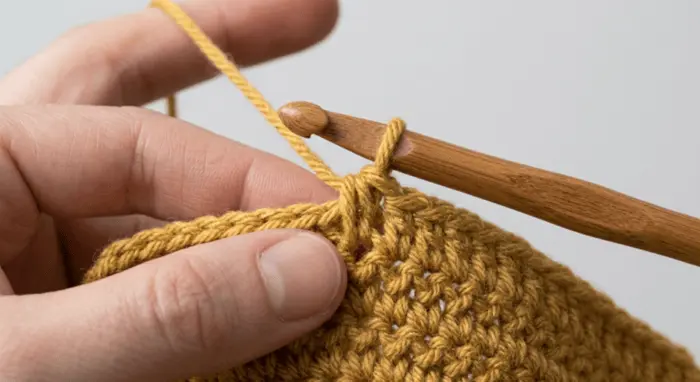
Pull the yarn through the stitch and straight through the loop on your hook, in one motion. You’re left with one loop on the hook. That’s one slip stitch.
How to Slip Stitch Crochet in a Row (Practice Swatch)
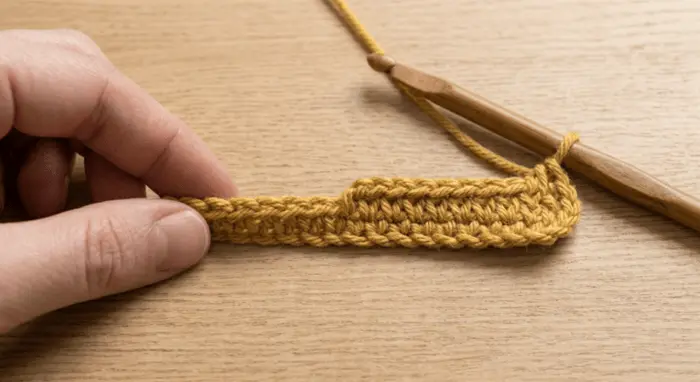
Make the foundation chain
Chain 21. If you need help, see our guide to how to start a crochet chain.
Slip stitch across the chain
Skip the chain nearest the hook. Work a slip stitch in the 2nd chain from the hook, then in each chain across. You should have 20 slip stitches.
Add a row of slip stitch
Chain 1 and turn. Work a slip stitch in each stitch across.
Which loop should you work in?
| Loop | Result |
|---|---|
| Both top loops (the V) | The standard slip stitch |
| Back loop only | A stretchy, ribbed look |
| Front loop only | A ridge on the other side |
| Bottom bump of the chain | A neat cord or edge |
How to keep slip stitches loose
Slip stitches tighten easily, because there’s no second yarn over to loosen the loop. To keep them workable:
- Relax your grip and pull the loop up a little before you finish each stitch.
- Use a bigger hook for rows of slip stitch, often one or two sizes larger.
- Work a row of single crochet first when practicing, as a tidy base.
What Is a Slip Stitch Used For?
How to join a round with a slip stitch
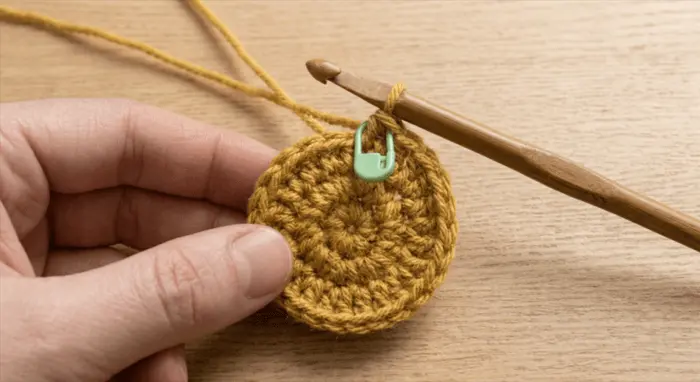
- Find the first stitch of the round. Use a stitch marker, placed under the two top loops of that stitch.
- Insert your hook under both loops of the first stitch.
- Yarn over and pull through the stitch and the loop on your hook.
- Chain up for the next round if your pattern says to, usually 1 for single crochet and 2 or 3 for taller stitches.
Where to join: first stitch or beginning chain?
| Pattern says | Where to slip stitch | Why |
|---|---|---|
| Join to the first stitch | The top of the first real stitch of the round | The starting chain doesn’t count as a stitch |
| Join to the top of the beginning chain | The top chain of your starting chain | The chain counts as the first stitch (such as ch 3 as a double crochet) |
| Join to form a ring | The first chain of your foundation chain | You’re making a ring |
Patterns differ, so follow yours and use the same spot every round.
Does a slip stitch count as a stitch?
| Situation | Counts as a stitch? |
|---|---|
| Joining slip stitch at the end of a round | Usually no. It’s a technique to connect the round |
| A whole row or round of slip stitches | Yes, each one |
| Slip stitches used to move across stitches | Usually no |
A few guides count the joining slip stitch, so read your pattern’s stitch count notes and follow them. If you work into the joining slip stitch by mistake, you’ll gain a stitch every round. Skip it and work your next stitch into the first real stitch.
Join snug, not strangled
A snug join sits flat and nearly disappears after the next round. Tighten the loop on your hook a little before you insert the hook into the first stitch. If the next round is hard to start, you’ve made it too tight. Pull the loop up taller or use a hook one size bigger just for the join.
When you don’t need a join (spiral rounds)
If your pattern works in a continuous spiral, such as most amigurumi, you don’t join each round with a slip stitch. You use a stitch marker instead. See our amigurumi guide for why.
How to slip stitch to join a chain into a ring
Chain the number your pattern asks for. Insert your hook into the first chain you made, next to the slip knot, and slip stitch. You now have a ring to work your first round into.
How to move across a row without cutting the yarn
Work slip stitches across the stitches you want to skip over. They add no height, so you can reach a new starting point without cutting your yarn. Some patterns use this to decrease at the start of a row.
How to slip stitch a seam
- Line up the two pieces edge to edge.
- Insert your hook through both pieces.
- Slip stitch and repeat along the seam.
Work with right sides together to hide the seam inside, or wrong sides together for a decorative ridge. Use the back loops only for a less bulky seam.
How to work a slip stitch edging
Work a slip stitch into the edge stitches for a smooth, firm border. A rough guide is one slip stitch per row of single crochet and two per row of double crochet. Keep the tension loose, or the edge will pucker.
Slip Stitch Variations
Back loop only slip stitch
This makes a stretchy, ribbed fabric, popular for hat brims and cuffs.
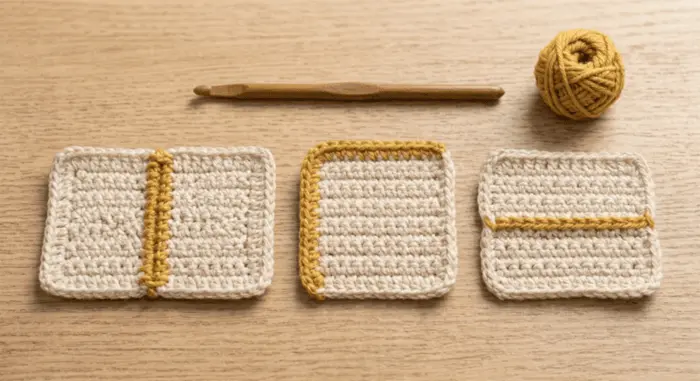
Surface slip stitch
Insert your hook through the front of your finished fabric, pull up a loop and slip stitch from point to point to draw a decorative line. It looks like a chain stitch drawn on top of your work.
Slip stitch cords
Slip stitch into the bottom bump of a foundation chain to make a simple cord.
Slip stitch fabric
You can make a whole piece in slip stitch, but it’s very dense, so most patterns use it sparingly.
Common Mistakes and Fixes
| Problem | Why it happens | Fix |
|---|---|---|
| Stitches are too tight | There’s no second yarn over to loosen the loop | Relax your grip or use a bigger hook |
| Can’t get the hook into the stitch | Tension is tight | Pull each loop up slightly before finishing |
| Next round is hard to start | The joining slip stitch is too tight | Pull the loop up taller or use a bigger hook for the join |
| Stitch count grows each round | Working into the joining slip stitch | Skip it and work into the first real stitch |
| Seam slants or drifts | Joining to different spots | Mark the first stitch and always join to it |
| Gap at the join | Joined into only one loop or the wrong stitch | Join under both loops of the first stitch |
| Edge puckers | Slip stitch edging is too tight | Loosen your tension or use a bigger hook |
| Seam looks bulky | Both loops used | Try the back loops only |
Left-Handed Slip Stitch
The steps are the same, only mirrored. Hold the hook in your left hand and the yarn in your right. A mirror or a left-handed video can help.
Frequently Asked Questions
How do you slip stitch in crochet?
Insert your hook into the next stitch, yarn over, and pull the yarn through both the stitch and the loop on your hook in one motion.
How do you do a slip stitch crochet in a row?
Chain, skip the chain nearest the hook, then slip stitch in each chain across. Keep your tension loose.
How do you make a slip stitch in crochet to join a round?
Insert your hook under both loops of the first stitch of the round and slip stitch. Then chain up if your pattern says to.
What is a slip stitch used for in crochet?
Joining rounds, moving yarn across a row, seaming, edging and decorative surface lines.
Does a slip stitch count as a stitch?
A joining slip stitch usually doesn’t. A row or round of slip stitches does. Follow your pattern’s notes.
What is the difference between a slip stitch and a single crochet?
A slip stitch is the shortest stitch and adds almost no height. A single crochet is taller and builds fabric.
What is the difference between a slip stitch and a slip knot?
A slip knot is the first loop on your hook. A slip stitch is a stitch you work into your fabric.
Why are my slip stitches so tight?
There’s no second yarn over to loosen the loop. Relax your grip or use a bigger hook.
Where do I put the slip stitch to join a round?
Usually the top of the first stitch of the round. If the beginning chain counts as a stitch, join to the top of that chain.
Do I always need to join rounds?
No. Spiral rounds, common in amigurumi, don’t need a join.
Is a slip stitch the same in UK and US terms?
Yes. The name is the same, and UK patterns often abbreviate it as ss.
Can you crochet a whole project in slip stitch?
Yes, but the fabric is very dense, so it’s usually used for ribbing and small accents.
Final Thoughts
The slip stitch is quick to learn and endlessly useful: insert, yarn over, pull through. Practice it across a chain, learn how to join a round neatly and keep your tension loose.
Next, learn the magic ring, try the half double crochet or see how to read crochet patterns.
Instructions are cross-checked against several published tutorials. Patterns vary, so always follow your pattern’s notes.
Related: Slip stitches also make neat color changes in the round.