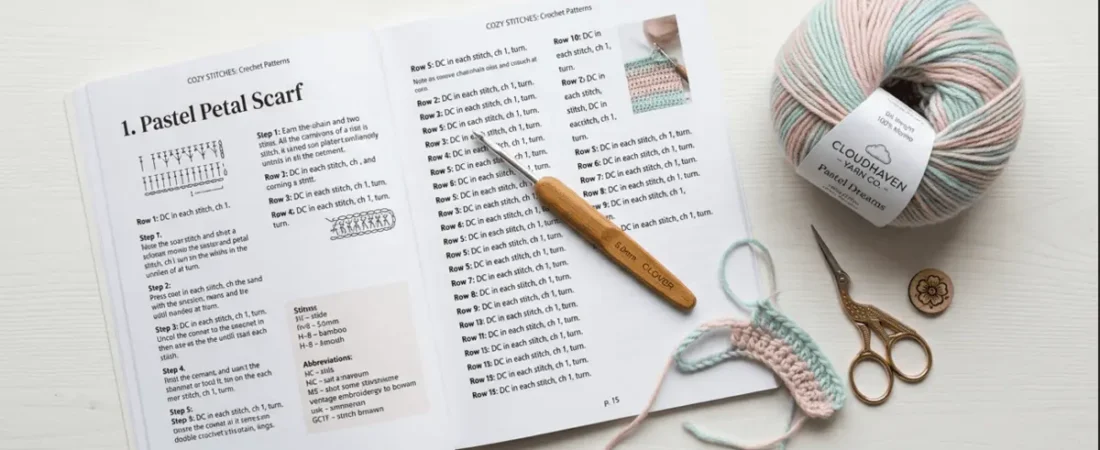
If crochet patterns look like a secret code written in another language, you’re not alone. All those abbreviations, numbers, asterisks, and brackets stop many beginners before they ever pick up a hook. The good news: you don’t have to memorize everything at once. You only need to understand the one line in front of you.
This guide breaks down exactly how to read crochet patterns — written instructions and symbol charts, in both US and UK terms — with a real pattern decoded line by line at the end. By the time you finish, you’ll be able to open almost any beginner pattern and know precisely what to do.
How Do You Read Crochet Patterns?
To read a crochet pattern, work through it one line at a time from top to bottom, decoding the abbreviations (like sc, dc, ch), following the punctuation that tells you when to repeat, and checking your stitch count at the end of each row or round. Every pattern is really just a sequence of small, repeatable instructions.
Here’s the simple workflow experienced crocheters use:
- Read the whole pattern first before you make a single stitch, so nothing surprises you halfway through.
- Check whether it’s written in US or UK terms (this changes what each stitch means).
- Gather your materials and make a gauge swatch if size matters.
- Work one line at a time, pausing at each comma to complete that instruction.
- Count your stitches at the end of each row or round to confirm you’re on track.
That’s the entire skill. The rest of this guide explains each piece.
The Anatomy of a Crochet Pattern
Before the actual stitch instructions, every good pattern gives you setup information. Knowing what each section means saves you from mistakes later.
- Title & skill level — Beginner, Easy, Intermediate, or Advanced. Treat this as a guide to the techniques used, not a reason to talk yourself out of trying.
- Materials — the yarn weight, how much you need, hook size, and any extras like a stitch marker, tapestry needle, or stuffing.
- Gauge (or “tension” in UK patterns) — how many stitches and rows fit in a set measurement, usually a 4-inch (10 cm) square. Matching gauge matters for anything that needs to fit, like a garment or hat.
- Notes — special construction details, whether you work in rows or rounds, color changes, and left-handed adjustments.
- Special stitches — any non-standard stitches the designer uses, explained before the main instructions. Bookmark this section; you’ll refer back to it.
- Abbreviations key — the shorthand list specific to that pattern.
Crochet Abbreviations Every Beginner Should Know
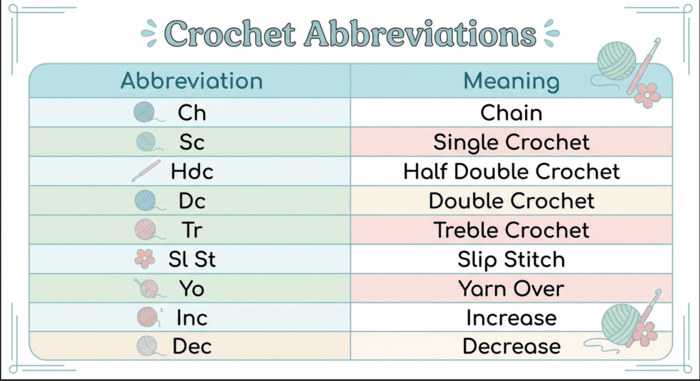
Crochet abbreviations are shorthand codes that keep patterns short and readable — for example, “sc” means single crochet and “ch” means chain. You don’t need to learn them all; just refer back to a list as you go. Here are the essentials:
| Abbreviation | Meaning |
|---|---|
| ch | chain |
| sl st | slip stitch |
| sc | single crochet |
| hdc | half double crochet |
| dc | double crochet |
| tr | treble (triple) crochet |
| st(s) | stitch(es) |
| yo | yarn over |
| sk | skip |
| sp | space |
| inc | increase (add a stitch) |
| dec | decrease (remove a stitch) |
| rep | repeat |
| rnd(s) | round(s) |
| RS / WS | right side / wrong side |
| BLO / FLO | back loop only / front loop only |
| tog | together |
Tip: Print a one-page abbreviation cheat sheet and keep it beside you while you work. You’ll have it memorized within a few projects.
US vs UK Crochet Terms (and How to Tell Which You Have)
This trips up more beginners than anything else. US and UK patterns use the same words for different stitches — a US single crochet is a UK double crochet. They’re not just different names; they’re mechanically different stitches with different heights.
| US Term | UK Term |
|---|---|
| single crochet (sc) | double crochet (dc) |
| half double crochet (hdc) | half treble crochet (htr) |
| double crochet (dc) | treble crochet (tr) |
| treble crochet (tr) | double treble crochet (dtr) |
| slip stitch (sl st) | slip stitch (ss) — same |
| gauge | tension |
| yarn over (yo) | yarn over hook (yoh) |
How to tell which system a pattern uses: if it mentions “single crochet,” it’s almost certainly US, because the UK system has no stitch called single crochet. If the tallest basic stitch it uses is “treble,” it’s likely UK. Many patterns also state their terminology at the top — always check first.
How to Read Crochet Symbols and Charts
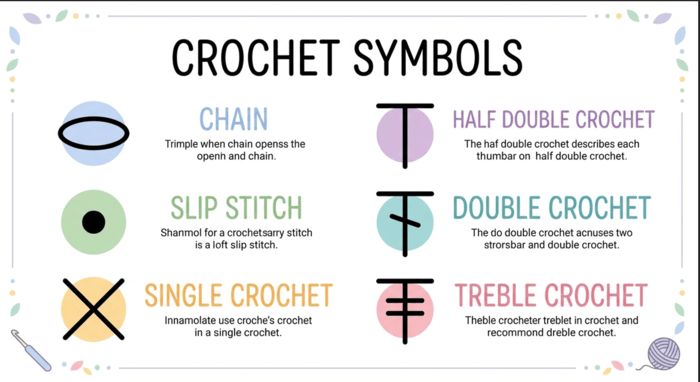
A crochet chart (or diagram) is a visual version of a pattern where each symbol represents one stitch. Charts are excellent for visual learners and for lace or motif patterns where a picture is clearer than words.
Here’s how to read one:
- Find the legend/key first — it tells you what each symbol means.
- Start at the beginning stitch. For rows, start at the bottom. For work in the round, start in the center and work outward.
- Read direction: bottom to top, and right to left for right-handers (left to right for left-handers).
- Row numbers mark where each row or round begins.
Common symbols to recognize:
- Oval = chain
- Dot = slip stitch
- X or + = single crochet
- T = half double crochet
- T with one crossbar = double crochet
- T with two crossbars = treble crochet
Once you know these six, you can read most beginner charts.
Understanding Crochet Punctuation
Patterns use punctuation to pack a lot of instruction into a small space. This is the “grammar” of crochet:
- Comma (,) — a pause. Complete the instruction before it, then move on. “Ch 1, sc in each st” = chain one, then single crochet in each stitch.
- Asterisks (* *) — mark a section to repeat. “*sc, 2sc in next st* repeat around” means repeat everything between the asterisks all the way around.
- Brackets [ ] — another way to group a repeat, usually with a multiplier. “[7sc, inc] x 6” = do “7 single crochet, then an increase” six times.
- Parentheses ( ) — two jobs. They either group stitches worked into one place — “(dc, ch 3, dc) in next st” — or, at the end of a row, they tell you your stitch count: “(20 sc)” means you should have 20 stitches.
Repeats and Stitch Counts
Almost every pattern contains a repeat — it’s how designers avoid writing out 200 identical stitches. When you see asterisks or brackets, you’re repeating a mini-sequence.
The number at the end of a line (usually in parentheses) is your stitch count — the total stitches you should have when the row or round is done. Count every time. If your count is off, catching it now saves you from unraveling later. If no count is given, it usually means the count hasn’t changed from the previous row.
Turning Chains, Rows, and Rounds
Working in rows: at the end of a row you’ll often see “ch 1, turn” (or ch 2, ch 3 depending on stitch height). This turning chain lifts your yarn to the height of the next row. Sometimes the pattern says “ch 3 (counts as a dc)” — meaning that turning chain replaces the first stitch, so you don’t work an extra one.
Working in rounds: patterns start with a magic ring (adjustable loop) or a chain joined into a circle, then spiral or join outward. Amigurumi (crocheted toys) is almost always worked in continuous rounds — you’ll see “Rnd 1: 6 sc in magic ring (6)” and keep spiraling, using a stitch marker to track where each round begins.
How to Read Patterns in Multiple Sizes
Garment patterns give several sizes at once, separated by parentheses:
Sizes: S (M, L) … To Fit Bust: 32 (36, 40)” … Finished Bust: 36 (40, 44)”
Pick your size and follow the matching number throughout the entire pattern. If you’re making a Medium, you use the second number every single time a set of options appears. Many crocheters highlight their size before starting so they never lose track.
Worked Example: Reading a Real Pattern Line by Line
Let’s decode a simple washcloth so you can see it all in action.
Row 1: Ch 21, sc in 2nd ch from hook and in each ch across, turn. (20 sc)
Row 2: Ch 1, sc in each st across, turn. (20 sc)
Rows 3–20: Repeat Row 2.
Fasten off.
Here’s exactly what that means:
- Row 1: Make 21 chain stitches. Skip the first chain closest to the hook, then work a single crochet into the second chain and into every chain after it. Turn your work. You now have 20 single crochet stitches. (That skipped first chain is gone forever — you never work back into it.)
- Row 2: Chain 1 to bring your yarn to height, single crochet once into each of the 20 stitches, then turn. Still 20 stitches.
- Rows 3–20: Do exactly what Row 2 says, eighteen more times.
- Fasten off: cut the yarn, pull it through the last loop, and weave in the end.
That’s a finished washcloth — and you just read a full crochet pattern.
How to Identify a Crochet Pattern
To identify whether a pattern is crochet (not knitting), look for a single hook, terms like “chain,” “single crochet,” or “double crochet,” and abbreviations such as ch, sc, and dc. Knitting patterns instead reference two needles and use terms like “knit (k),” “purl (p),” and “cast on.”
To identify the type of crochet pattern, check the format: written patterns read like a recipe, line by line, while charted/diagram patterns use symbols. And check the terminology (US or UK) and the construction (rows vs. rounds) before you start.
Common Beginner Mistakes to Avoid
- Not checking US vs UK terms — the number-one cause of a project turning out wrong.
- Working into the wrong first chain — remember to skip the first chain in single crochet rows.
- Miscounting the turning chain — know whether it “counts as” a stitch or not.
- Skipping the gauge swatch — fine for a washcloth, disappointing for a sweater.
- Not reading the whole pattern first — surprises halfway through cause the most frustration.
How to Learn Crochet Patterns Faster
The fastest way to get fluent is to start with a very simple pattern and decode it completely before you stitch. Beyond that:
- Keep an abbreviation cheat sheet within reach.
- Learn just the six core stitches first (ch, sl st, sc, hdc, dc, tr).
- Practice on small, quick projects like coasters, washcloths, or granny squares.
- Watch a video alongside a written pattern to connect the words to the motions.
- Highlight repeats and check off each row as you finish it.
Confidence comes from repetition, not memorization. Three or four small projects and reading patterns will feel natural.
Frequently Asked Questions
How do you read crochet patterns?
Read a crochet pattern one line at a time from top to bottom. Decode the abbreviations (like sc, dc, ch), follow the punctuation that signals repeats (asterisks and brackets), and check the stitch count in parentheses at the end of each row or round. Always confirm whether the pattern uses US or UK terms before starting.
How do you read symbols for crochet?
Each symbol in a crochet chart represents one stitch — for example, an oval is a chain, an X or + is a single crochet, and a T with one crossbar is a double crochet. Find the chart’s legend first, then start at the bottom (for rows) or the center (for rounds) and read right to left for right-handers.
How do you identify a crochet pattern?
Crochet patterns reference a single hook and use terms like chain, single crochet, and double crochet (ch, sc, dc), while knitting patterns use two needles and terms like knit and purl. To identify the pattern type, note whether it’s written line by line or shown as a symbol chart, and whether it uses US or UK terminology.
How do you read a crochet pattern in the UK?
UK patterns use the same stitch names as US patterns but for different stitches — a UK double crochet is a US single crochet, and a UK treble is a US double crochet. If a pattern’s shortest basic stitch is “double crochet” and it uses “tension” instead of “gauge,” it’s written in UK terms.
What is the most popular crochet pattern?
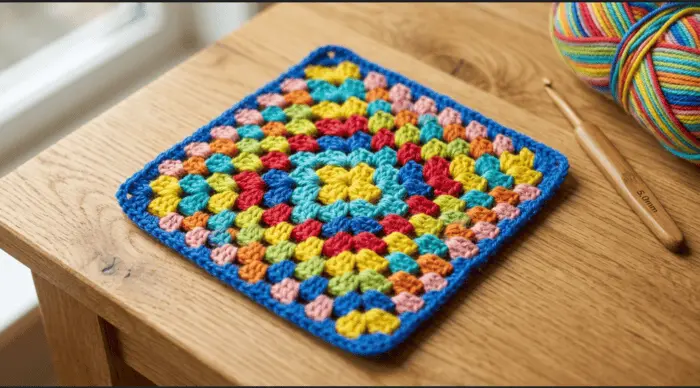
The granny square is the most popular and iconic crochet pattern — a simple, endlessly repeatable motif used for blankets, cardigans, and bags. Other beginner favorites include the classic granny square blanket, simple beanies, scarves, and amigurumi toys.
How do you learn crochet patterns?
Learn crochet patterns by starting with a beginner project, keeping an abbreviation cheat sheet nearby, and mastering the six core stitches first. Practice on small items like washcloths and granny squares, and read each pattern all the way through before you begin.
Final Thoughts
Reading crochet patterns is a skill, not a talent — and it clicks faster than you’d expect. Learn the abbreviations, respect the punctuation, always check US vs. UK terms, and count your stitches. Do that, and every pattern becomes just a series of small steps you already know how to take. Grab a simple pattern, keep this guide open, and start with Row 1.