
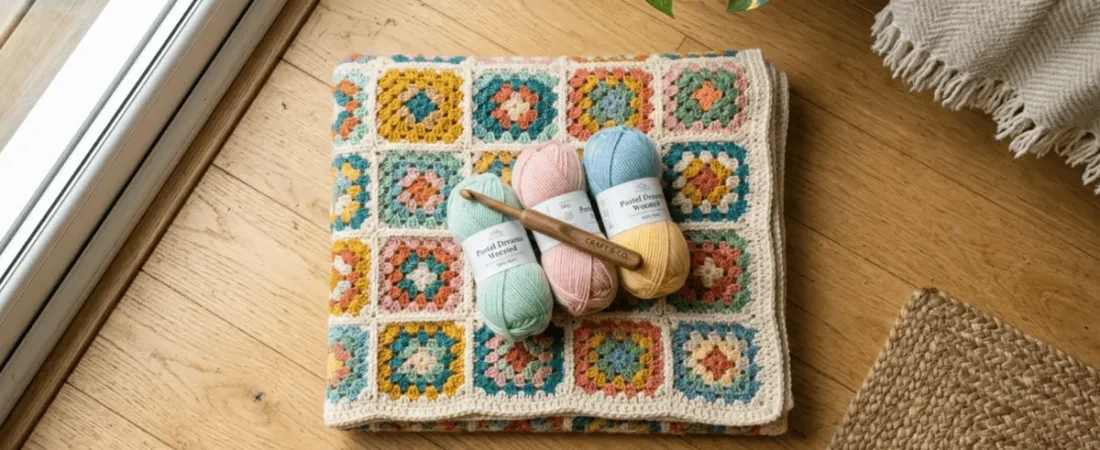
There’s a reason the granny square blanket never goes out of style. It’s beginner-friendly, endlessly customizable, portable enough to make one square at a time on the sofa, and it turns leftover yarn into something you’ll actually keep. If you can chain and double crochet, you can make this blanket.
This guide walks you through everything: a free classic granny square pattern, exactly how many squares you’ll need for any blanket size, the best way to join them, how to add a border, and whether to block. Let’s get hooked.
What is a granny square blanket?
A granny square blanket is a crochet blanket made from small square motifs — “granny squares” — that are crocheted separately and then joined together into one large piece. Each square is worked in rounds from the center out, usually with clusters of double crochet stitches separated by chain spaces, which gives the square its classic open, lacy look. You can make a blanket from dozens of small squares or from a single giant square, depending on the style you want.
Why it’s the perfect beginner blanket
Granny squares are the classic first “real” crochet project, and for good reason:
- You only need two stitches — the chain and the double crochet.
- Squares are small and quick, so you get the satisfaction of finishing something fast.
- It’s portable — carry a few squares in your bag and work anywhere.
- It’s forgiving — a slightly wonky square disappears once it’s joined and bordered.
- It’s scrap-friendly — use up odd balls of yarn in a happy, colorful mix.
What you’ll need
Yarn: Worsted weight / medium (#4) yarn is the most popular choice for granny square blankets — it’s easy to handle, works up at a good pace, and is widely available. For a soft baby blanket, DK (#3) is lovely; for a fast, cozy throw, chunky (#5–6) yarn like a blanket yarn works up in a fraction of the time.
Hook: A 5.0 mm (US H-8) or 5.5 mm (US I-9) hook pairs well with worsted yarn. Always check your yarn label and adjust to get a fabric you like.
Notions: Scissors, a tapestry (yarn) needle for weaving in ends, and stitch markers if you like to mark corners.
How to crochet a basic granny square (free pattern)
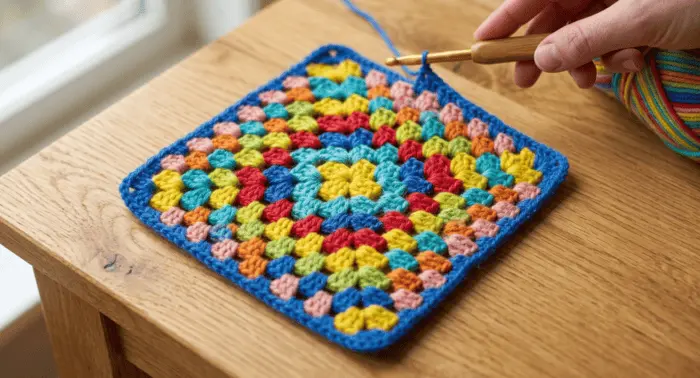
This is the classic granny square in US terms. Each square is about 6 inches (15 cm) after 4 rounds in worsted weight — the size we’ll use for the blanket math later.
Abbreviations: ch = chain, dc = double crochet, sl st = slip stitch, sp = space.
Start: Make a magic ring (or chain 4 and join with a sl st to form a ring).
Round 1: Ch 3 (counts as your first dc here and throughout). Work 2 dc into the ring, then ch 2 to make the first corner. Work 3 dc into the ring, ch 2. Repeat from * two more times. Join with a sl st to the top of the beginning ch-3. You now have four 3-dc groups and four ch-2 corners.
Round 2: Sl st across into the nearest ch-2 corner space. In that space work (ch 3, 2 dc, ch 2, 3 dc) — that’s your first corner made. Ch 1, then in the next corner space work (3 dc, ch 2, 3 dc). Repeat from * around. Ch 1 and join with a sl st to the beginning ch-3.
Round 3: Sl st into the corner space. In each corner space work (ch 3, 2 dc, ch 2, 3 dc). Along each side, work 3 dc into the ch-1 space, with ch 1 between each group. Join with a sl st.
Round 4: Repeat Round 3, remembering that as the square grows, each side gains one more 3-dc group. Corners always get (3 dc, ch 2, 3 dc); sides always get 3 dc in each ch-1 space with ch 1 between.
Finish: Fasten off and weave in your ends (or leave the last round in a joining color — more on that below). That’s one square. Now make a lot of them!
How many squares do you need? (Size chart)
The number of squares depends on your square size and the blanket size you want. Using standard 6-inch squares, here’s roughly what you’ll need:
| Blanket | Approx. size | Layout (6″ squares) | Squares needed |
|---|---|---|---|
| Lovey / mini | 18 × 18 in | 3 × 3 | 9 |
| Baby blanket | 36 × 36 in | 6 × 6 | 36 |
| Lapghan | 36 × 48 in | 6 × 8 | 48 |
| Throw | 48 × 60 in | 8 × 10 | 80 |
| Twin | 60 × 90 in | 10 × 15 | 150 |
Want fewer squares? Make them bigger. A 12-inch square covers four times the area of a 6-inch one, so a throw that needs 80 small squares needs only about 20 large ones — faster to join, but with less room for color play.
How to join granny squares
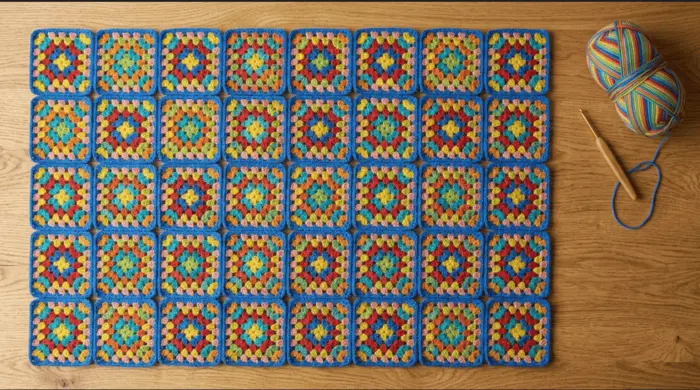
Once your squares are made, you join them into a blanket. The four most common methods:
- Join-as-you-go (JAYG): You connect each square to its neighbors while crocheting the final round. Least sewing, very tidy — a favorite for beginners once they’ve made a few squares.
- Whip stitch: Hold two squares together and sew through the back loops with a tapestry needle. Simple and beginner-friendly.
- Slip stitch join: Crochet the squares together with slip stitches for a raised, defined ridge on the front.
- Single crochet join: Like the slip stitch join but with single crochet, giving a slightly bolder seam.
Whichever you choose, lay all your squares out first and take a photo of the arrangement you like, so you can join them in the right order.
Adding a border
A border frames the blanket and tidies the edges. A simple, reliable border: work a round of double crochet (or half double crochet) evenly around the whole blanket, placing 3 stitches into each of the four corners so they lie flat. Add as many rounds as you like — a classic granny-stripe border in a coordinating color looks beautiful. Finish the final round with a round of single crochet for a clean edge.
Should you block it?
Blocking is worth it. Wet or steam blocking evens out your stitches, opens up the lacy pattern, squares up any wobbly edges, and makes the finished blanket drape better. Block the individual squares before joining if you want them perfectly uniform, or block the whole blanket at the end.
Beginner tips for a blanket you’ll love
- Make a few squares first, then check your size before committing to a color plan.
- Keep your tension consistent — it matters more than perfection.
- Buy enough yarn in the same dye lot so colors match across the whole blanket.
- Weave in ends as you go rather than leaving hundreds for the end.
- Use a limited color palette (3–5 colors) for a modern look, or go full scrap-blanket for cozy chaos.
Frequently Asked Questions
How many granny squares do I need to make a blanket?
It depends on your square size and your target blanket size. With 6-inch squares, a baby blanket (36 × 36 in) needs about 36 squares, a lapghan needs around 48, and a throw (48 × 60 in) needs about 80. Bigger squares mean fewer squares overall — a 12-inch square covers the area of four 6-inch squares.
How do you make a granny square blanket for beginners?
Crochet a batch of identical basic granny squares, lay them out in a grid you like, join them together (join-as-you-go or whip stitch are easiest), then add a simple double crochet border around the edge. Start small with a baby blanket so you finish quickly and build confidence.
What is the best granny square for a blanket?
The classic granny square — clusters of 3 double crochet separated by chain spaces — is the best all-rounder: it’s fast, beginner-friendly, and joins neatly. Solid granny squares (no gaps) make a warmer, denser blanket, while sunburst and flower squares add decorative flair if you want something fancier.
How do you turn a granny square into a blanket?
Keep working rounds on a single square until it reaches blanket size (a “giant granny square” blanket), or make many smaller squares and join them into a grid. Both are valid — one big square means no joining, while many small squares give you more color options.
What size yarn should I use for a granny square blanket?
Worsted weight (medium, #4) is the most popular and versatile choice. Use DK (#3) for a softer, lighter baby blanket, or chunky/blanket yarn (#5–6) if you want the blanket to work up much faster with bigger, quicker squares.
What is the quickest crochet stitch for a blanket?
The double crochet is the quickest of the common stitches because it’s tall and covers ground fast — which is exactly why granny squares (built from double crochet) work up so quickly. For an even speedier blanket, use chunky yarn with a large hook.
What is the best crochet border for a granny square blanket?
A double crochet or half double crochet border with 3 stitches in each corner is the most reliable, lies flat, and suits any blanket. For a decorative finish, add a granny-stripe border in a coordinating color, then a final round of single crochet or a simple picot edge.
How many hours does it take to make a granny square blanket?
A single 6-inch, 4-round square takes roughly 15–25 minutes once you’re comfortable, so a baby blanket of 36 squares is around 10–15 hours plus joining and border, and a full throw can take 25–40+ hours total. Chunky yarn and larger squares cut that time significantly.
What is the easiest blanket to crochet for beginners?
A granny square baby blanket is one of the easiest, because you repeat one simple small square many times and the project stays manageable. A single giant granny square blanket is even simpler to join (there’s nothing to join), making it a great first blanket.
What is the prettiest crochet stitch for a blanket?
That’s personal, but popular “pretty” choices include the classic granny stitch, the puff stitch, the shell stitch, and the sunburst granny square, all of which add lovely texture. For a blanket, texture plus a thoughtful color palette usually matters more than the specific stitch.
How big is a granny square blanket?
As big as you make it. Common finished sizes are about 18 × 18 in for a lovey, 36 × 36 in for a baby blanket, 36 × 48 in for a lapghan, and 48 × 60 in for a throw. Because you simply add or remove squares, you can make any size you like.
Should I block my granny squares for a blanket?
Yes, blocking is recommended. It evens out your stitches, opens up the granny pattern, straightens wobbly edges, and helps every square match in size, giving a neater, better-draping blanket. You can block individual squares before joining or block the whole blanket at the end.
Ready to start?
Grab your favorite worsted yarn and a 5.0 mm hook, make your first classic granny square, and you’re on your way to a blanket that could become a family keepsake. Start with a baby-blanket size to build momentum, then go as big as you like. Happy hooking!