
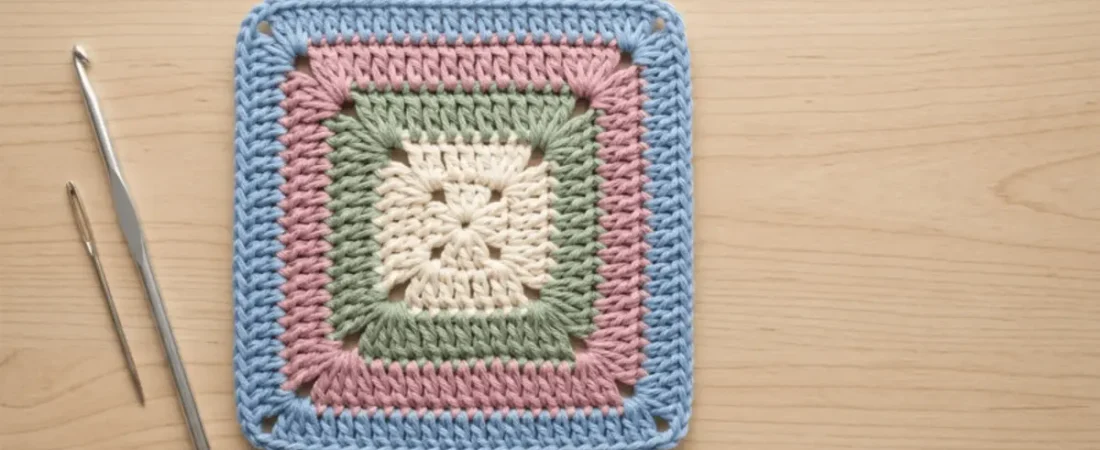
To crochet a solid granny square, work a double crochet in every stitch along each side and (2 dc, ch 2, 2 dc) in each corner. Each round adds 16 stitches: round 1 has 12, round 2 has 28 and round 3 has 44.
Pattern at a Glance
| Skill level | Beginner |
| Stitches | Chain, slip stitch, double crochet (US) |
| Yarn | Worsted weight (#4), or any weight |
| Hook | 5 mm (H-8), or the size on your yarn label |
| Time | Roughly 20 to 40 minutes for a 4-round square while learning |
| Finished size | About 5 to 6 inches after 4 rounds (measure yours) |
Key Takeaways
- A solid granny square has no lacy gaps along the sides. It doesn’t mean one color.
- Every side stitch is a double crochet. Every corner is (2 dc, ch 2, 2 dc).
- Total stitches per round = 16 × round number − 4.
- The beginning ch 3 counts as a stitch in every round.
- US double crochet (dc) is called treble (tr) in UK terms.
What Is a Solid Granny Square?
A solid granny square is a granny square worked with a double crochet in every side stitch instead of clusters separated by chain gaps. The result is a dense, flat fabric.
Crocheters also call it a granny square with no gaps. “Solid” describes the stitch pattern, so you can still change colors every round.
Solid vs Classic Granny Square
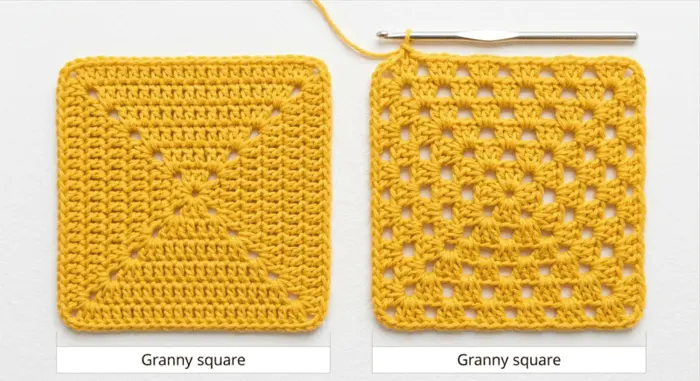
| Feature | Solid granny square | Classic granny square |
|---|---|---|
| Sides | Double crochet in every stitch | 3-dc clusters with ch-1 gaps |
| Look | Dense, flat, no holes along the sides | Lacy and open |
| Corners | (2 dc, ch 2, 2 dc) | (3 dc, ch 2, 3 dc) |
| Stitches added per round | 16 | Varies by pattern |
| Best for | Blankets, cushions, bags, dishcloths | Lightweight throws and shawls |
US vs UK Crochet Terms
This pattern uses US terms.
| US term | UK term |
|---|---|
| Double crochet (dc) | Treble (tr) |
| Single crochet (sc) | Double crochet (dc) |
| Slip stitch (sl st) | Slip stitch (ss) |
If you use UK terms, swap dc for tr. The pattern works exactly the same.
Materials You Need
- Yarn: worsted weight (#4) is easiest to see and work. Any weight works.
- Hook: 5 mm (H-8) as a starting point. Follow your yarn label.
- Yarn needle for weaving in ends.
- Scissors.
- Stitch marker (optional) to mark a corner.
Use cotton for dishcloths and coasters, and a soft acrylic or cotton blend for blankets.
Abbreviations
| Abbreviation | Meaning |
|---|---|
| ch | Chain |
| sl st | Slip stitch |
| dc | Double crochet (US) |
| sp | Space |
How to Crochet a Solid Granny Square, Step by Step
Round 1: Start the Square
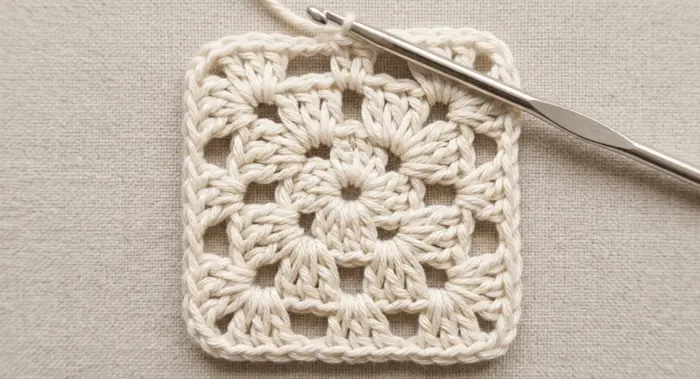
- Make a magic ring.
- Ch 3 (counts as your first dc), then work 2 dc in the ring.
- Ch 2. This is your first corner.
- Work 3 dc in the ring, then ch 2. Repeat this twice more.
- Join with a sl st to the top of the beginning ch 3.
- Pull the tail to close the ring.
Count: 12 dc and four ch-2 corner spaces.
No magic ring? Ch 4, join with a sl st to make a ring, and work into the center. This leaves a small hole.
Round 2: Build the Corners
- Join yarn with a sl st in any ch-2 corner space.
- Ch 3, work 1 dc in the same space, ch 2, then work 2 dc in the same space.
- Work 1 dc in each of the next 3 dc.
- Work (2 dc, ch 2, 2 dc) in the next corner space.
- Repeat steps 3 and 4 two more times.
- Work 1 dc in each of the last 3 dc.
- Join with a sl st to the top of the beginning ch 3.
Count: 28 dc.
Round 3 and Beyond: Grow the Square
- Join in any corner space. Ch 3, 1 dc, ch 2, 2 dc in the same space.
- Work 1 dc in each dc along the side.
- Work (2 dc, ch 2, 2 dc) in the next corner space.
- Repeat for all four sides.
- Join with a sl st to the top of the beginning ch 3.
Repeat this round until the square is the size you want.
Stitch Count Chart
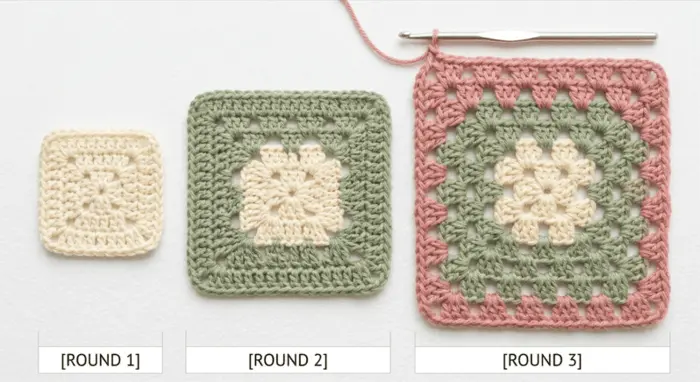
| Round | dc per side | Total dc |
|---|---|---|
| 1 | 3 | 12 |
| 2 | 7 | 28 |
| 3 | 11 | 44 |
| 4 | 15 | 60 |
| 5 | 19 | 76 |
| 6 | 23 | 92 |
Formula: total dc = 16 × round − 4. Per side = 4 × round − 1.
Each side count includes the 2 corner dc at each end. The ch-2 corner spaces aren’t counted.
Why Do Patterns Give Different Stitch Counts
Some patterns count the corner chains, and others build corners differently. A pattern that places fewer stitches in the corners will add fewer stitches per round.
This pattern adds 16 per round. Always count against your own pattern, and check each round before moving on.
Why Corners Use (2 dc, ch 2, 2 dc)
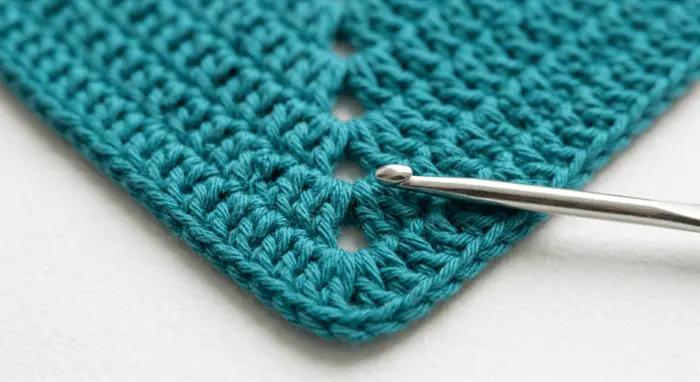
Corners are where the square turns. The ch 2 gives the corner room to bend flat, and the 2 dc on each side keep every side growing evenly.
If you use 3 dc on each side of a corner, you add extra stitches there and the corners ruffle. If you use only 1 dc, the corners pull in.
Rough Size Guide
These are estimates for worsted weight with a 5 mm hook. Your tension changes the result.
| Rounds | Approx. size |
|---|---|
| 3 | 4.5 to 5 inches |
| 4 | 5.5 to 6 inches |
| 5 | 6.5 to 7 inches |
Measure your first square, then decide how many rounds you need.
How to Change Colors
Fasten off at the end of a round. Join the new color in any corner space and work as normal.
Corners are a good place to join, because the join hides in the corner. Weave the ends in along the edge of the stitches for a neat result.
How to Finish a Solid Granny Square
- Fasten off and leave a 6-inch tail.
- Thread the tail on a yarn needle.
- Weave in the ends through the back of the stitches.
- Block the square to size.
For an invisible join, skip the beginning ch 3, pass the needle under both loops of the next stitch, then through the back loop of the last stitch you made. Pull it snug.
How to Block Granny Squares
Blocking evens out edges and makes the square flat.
- Pin the square to a mat at its measured size.
- Mist it with water, or steam it without touching the iron to the yarn.
- Let it dry fully before unpinning.
Take care with acrylic, because direct heat can flatten or melt it.
Common Problems and Fixes
| Problem | Likely cause | Fix |
|---|---|---|
| Corners ruffle | Too many stitches in the corner | Use (2 dc, ch 2, 2 dc), not 3 dc |
| Sides bulge | An extra stitch on the side | Count against the chart |
| Sides pull in | A missed stitch or tension too tight | Recount and loosen up |
| Square is not square | Uneven counts per side | Make sure all four sides match |
| Wavy edges | Tension too loose | Try a smaller hook, and block |
| Bumpy join | Slip stitch join shows | Use an invisible join |
| Small hole in the center | Chain ring start | Use a magic ring |
Variations of the Solid Granny Square
- Single crochet granny square: denser and flatter, with a slightly different look.
- Half double crochet square: a middle ground in height and drape.
- Treble version: taller stitches, but small holes still appear in the corners.
- Multi-color rounds: change color every round for stripes.
- One color: a solid look that’s good for dishcloths and cushions.
How Much Yarn Do You Need?
Weigh your yarn before making one square, then weigh it again afterward. Multiply the difference by the number of squares you need, and add extra for borders and joining.
How to Join Solid Granny Squares
| Method | Best for |
|---|---|
| Join as you go | Blankets |
| Single crochet join | Bags and cushions |
| Whip stitch | Garments and scarves |
| Slip stitch join | Blankets and bags |
What to Make with Solid Granny Squares
- Coasters and dishcloths
- Cushion covers
- Bags and pouches
- Baby blankets and throws
For more ideas, see our guide to what to make with granny squares.
Frequently Asked Questions
What is a solid granny square?
A solid granny square is a granny square with a double crochet in every stitch along the sides, so there are no lacy gaps. It doesn’t mean a single color.
How do you crochet a granny square with no gaps?
Work a double crochet in each stitch along the sides, and (2 dc, ch 2, 2 dc) in each corner.
How many stitches are in each round of a solid granny square?
Round 1 has 12 dc, round 2 has 28 and round 3 has 44. The total is 16 × round − 4. Corner chains aren’t counted.
What is the difference between a classic and a solid granny square?
A classic granny uses clusters with ch-1 gaps for a lacy look. A solid granny uses a dc in every stitch for a dense fabric.
Do I need a magic ring?
No. Ch 4 and join with a sl st to make a ring. A magic ring just closes the center fully.
What yarn and hook should I use?
Worsted weight with a 5 mm hook is a good start. Use cotton for dishcloths and coasters.
How many rounds make a 6-inch square?
About 4 rounds in worsted weight with a 5 mm hook. Measure yours, because tension varies.
Why is my granny square wavy or not square?
Check your counts against the chart, make sure corners are (2 dc, ch 2, 2 dc), and block the square.
Are solid granny squares good for beginners?
Yes. They use only chain, slip stitch and double crochet.
Final Thoughts
A solid granny square comes down to two rules: a dc in every side stitch, and (2 dc, ch 2, 2 dc) in every corner. Count each round against the chart, and your squares will stay flat and even. Once you have a few, join them into a blanket or cushion.