
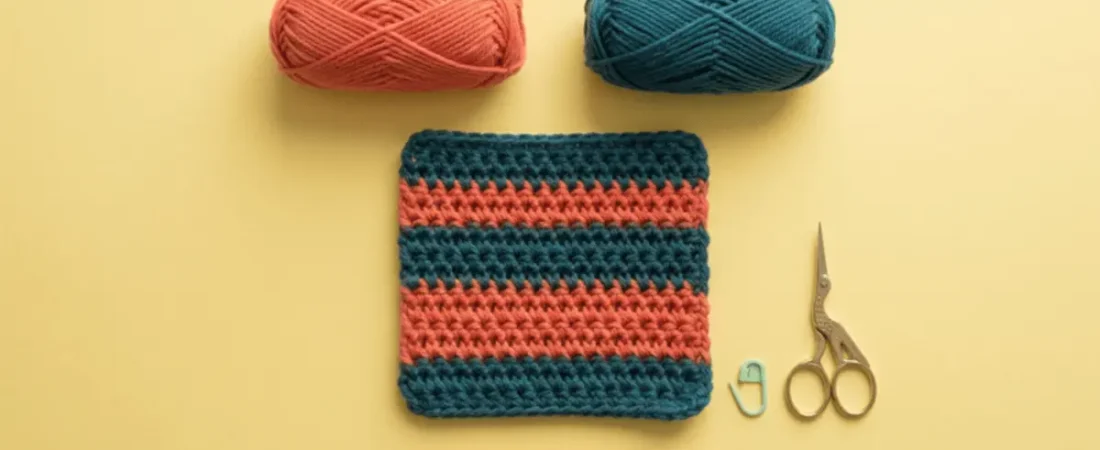
To change colors in crochet, work the last stitch of the old color until only the final pull-through remains, then pull the new color through to finish that stitch. The new color starts with the next stitch. In a single crochet that means two loops on the hook; in a half double crochet, three.
A color change (or “colour change” in UK spelling) means switching to a new yarn partway through your work, for stripes, color blocks or patterns. It looks fiddly the first time, but it is one small move. This guide covers changing colors at the end of a row, in the round and mid-row, plus how to keep stripes neat. New to crochet? Start with our crochet for absolute beginners guide and the 6 basic crochet stitches first.
By Zain, Crochet Patterns Hub. Last updated November 2026.
Key takeaways
- Change colors on the last pull-through of the stitch before the new color.
- The new color starts with the next stitch.
- Leave a 4 to 6 inch tail on both the old and new yarn.
- Pull the old tail taut to tighten the change.
- Cut the yarn for stripes; carry it only when you will use the color again within a stitch or two.
Which color change method should you use?
| Your situation | Best method | Jump to |
|---|---|---|
| Stripes in flat rows | Change on the last stitch of the row, then cut the yarn | End of a row |
| Amigurumi or other spiral rounds | Basic change, then a slip stitch to hide the jog | In the round |
| Granny squares or joined rounds | Slip stitch join in the new color | In the round |
| A color that returns within a few stitches | Carry the yarn behind the work | Carry or cut |
How to Change Colors in Crochet (The Basic Method)
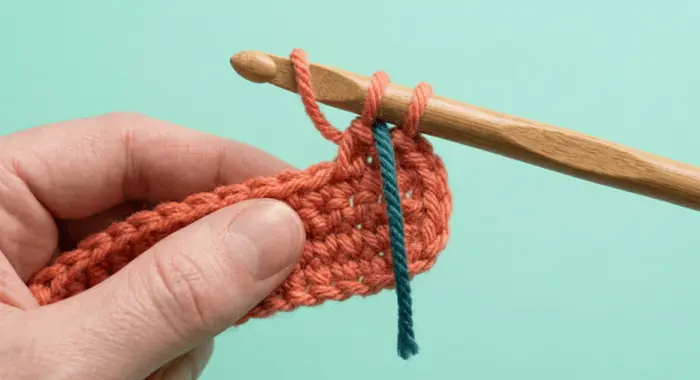
Short answer: work the last stitch in the old color until only the final pull-through is left, then pull the new color through. These steps work in rows or rounds, with any stitch.
Step 1: Work to the last stitch before the new color
Crochet as normal until you reach the last stitch of the old color.
Step 2: Start the last stitch, but stop before the final pull-through
Work the stitch until the final pull-through is all that remains. In a single crochet, that is two loops on the hook.
Step 3: Yarn over with the new color and pull through
Drape the new color over your hook, leaving a tail of 4 to 6 inches. Pull the new color through all the loops on the hook. The stitch is finished, now in the new color.
Step 4: Continue with the new color
Work the next stitch with the new color. Pull the old tail gently to tighten the change.
Where to change for each stitch
| Stitch (US terms) | Stop when… | Then pull the new color through… |
|---|---|---|
| Single crochet | You have 2 loops on the hook | Both loops |
| Half double crochet | You have 3 loops on the hook | All 3 loops |
| Double crochet | You have 2 loops left after the first pull-through | The last 2 loops |
Using UK terms? A UK double crochet is a US single crochet, so check your pattern’s language with our US/UK crochet terms converter or the crochet abbreviations glossary.
How to Switch Colors When Crocheting at the End of a Row
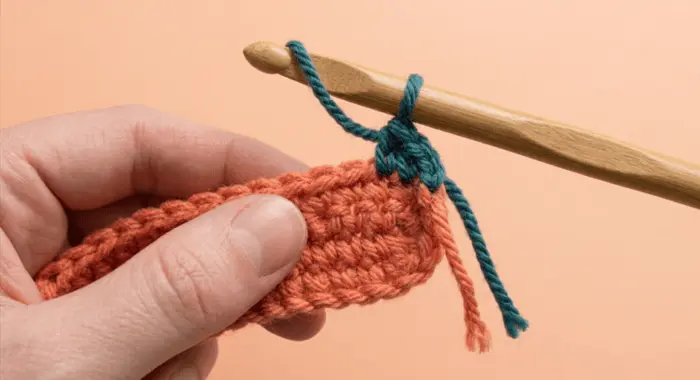
The standard method
Work to the last stitch of the row. Finish that stitch with the new color, as above. Then chain your turning chain in the new color and turn. Your new row is now in the new color. For a refresher on chains, see how to start a crochet chain.
An easier alternative
If the standard method feels fiddly, work the last stitch in the old color as normal. Then drop the old yarn, hold the new color alongside and chain 1 (or your turning chain) with the new color. It is a little less neat at the edge, but it is simple for beginners.
Keep your edges neat
- Break the yarn for stripes if you will not use the old color for a few rows.
- Pull the old tail taut to close any gap.
- Keep the turning chain loose.
How to Switch Colors in Crochet in the Round
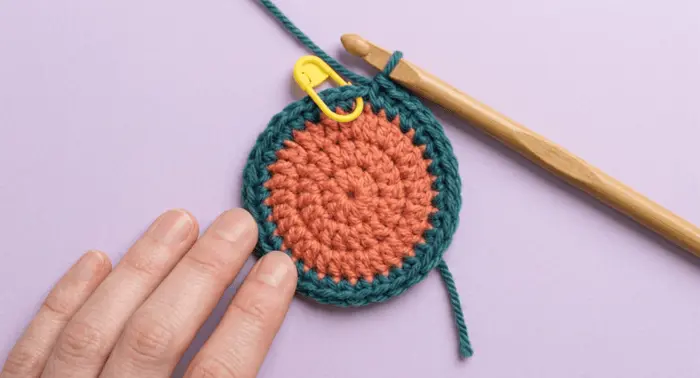
The method depends on how you work your rounds.
| Type of round | How to change colors |
|---|---|
| Spiral rounds (like most amigurumi) | Use the basic last-pull-through change, and start the round with a slip stitch to hide the jog |
| Joined rounds | Finish the last stitch in the old color, then join with a slip stitch using the new color |
| Joined rounds, neatest finish | Make an invisible finish with the old color, then start the new color with a standing stitch |
Spiral rounds (amigurumi)
Use the basic method on the last stitch of the old color. A small “jog” where the colors step up is normal in a spiral. To hide it, work a slip stitch into the first stitch of the new color’s round instead of a single crochet, and treat that slip stitch as a single crochet on the next round. If you need help, see our slip stitch guide and our amigurumi guide for beginners. Striping a round piece? Review the magic ring and how to increase in a crochet circle first, because stripes shift as you increase.
Joined rounds
- Finish the last stitch of the round in the old color, as normal.
- Insert your hook into the first stitch of the round.
- Yarn over with the new color and pull through the stitch and the loop on the hook. This is your slip stitch join, and it changes the color too.
- Chain up and continue the next round in the new color.
The joining slip stitch usually does not count as a stitch. This is the method used for colorful squares, so it pairs well with our solid granny square guide and how to attach granny squares.
The invisible finish
For the neatest result, cut the old color after the last stitch of the round. Pull the tail through the loop and sew the end into the first stitch so it looks like a real stitch. Then start the new color with a standing stitch in the first stitch. It takes more time, but the join almost disappears.
How to Change Colors in the Middle of a Row
Use the same last-pull-through method, wherever you are in the row.
- Work the stitch before the change until the final pull-through.
- Pull the new color through.
- Continue in the new color for as many stitches as you need.
If you will need the old color again soon, carry it behind the work. If not, cut it. Arrange your colors in the order you will use them before you start the row. To follow colorwork instructions, see how to read crochet patterns or paste a line into the crochet pattern decoder.
Carry the Yarn or Cut It?
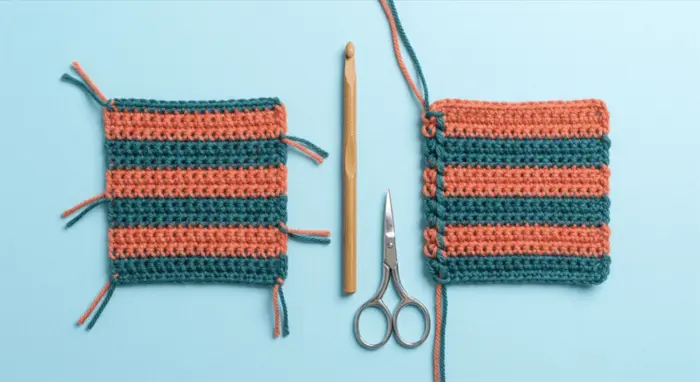
| Cut the yarn | Carry the yarn | |
|---|---|---|
| Best for | Stripes with a gap before the color returns | A color that returns within a stitch or two, or tapestry crochet |
| Pros | Clean edges and no bulk | No ends to weave in |
| Cons | More ends to weave | Edges can bulge or show little jumps |
How to deal with the ends
- Weave them in with a yarn needle once you finish.
- Or work over the tails for 3 or 4 stitches as you crochet, which holds them in place and saves weaving.
Plan Your Yarn Before You Stripe
Stripes use more yarn than a solid piece because of the extra ends and tails. Estimate each color with the crochet yarn calculator before you buy, and see the best yarn for crochet projects to pick a fiber that holds its color. Dark and light yarns can bleed when wet, so test colorfastness on a swatch first.
Projects to Practice Color Changes
- Easy crochet baby blanket pattern: simple stripes in flat rows.
- Crochet striped maxi dress pattern: stripes shaped around the body.
- Two-tone market tote: a clean two-color change.
- Granny square blanket: a new color every round.
Tips for Neat Stripes
- Change on the last yarn over, so the new color starts at the top of the stitch.
- Pull the old tail taut to remove loose loops.
- Leave a 4 to 6 inch tail every time.
- Keep your tension even, so the first stitch of the new color is not too tight. A relaxed hook and yarn hold helps.
- Practice on a swatch with two very different colors.
Common Mistakes and Fixes
| Problem | Why it happens | Fix |
|---|---|---|
| The first stitch of the new color looks messy | The loop is loose | Pull the old tail taut, and again before weaving in |
| A gap at the color change | Changed too early or too late | Change on the last pull-through of the stitch before |
| A visible jog in rounds | Normal in spirals | Start the round with a slip stitch |
| Bulky or jumpy edges | Carried yarn up the side | Cut the yarn instead |
| The color looks wrong | Changed one stitch early or late | The new color starts with the next stitch |
| Tight edge | The turning chain is tight | Loosen your tension |
| Colors look dull or bleed | Dark and light yarns bleed when wet | Check colorfastness before washing |
Left-Handed Color Changes
The steps are the same, only mirrored. Hold the hook in your left hand and the yarn in your right. A mirror or a left-handed video can help.
Frequently Asked Questions
How do you change colors in crochet?
Work the last stitch of the old color until the final pull-through, then pull the new color through to finish it. The next stitch is in the new color.
How do you change colors when crocheting at the end of a row?
Finish the last stitch of the row with the new color, then chain and turn in the new color.
How do you switch colors in crochet in the round?
In a spiral, use the same method and expect a small jog. In joined rounds, join with a slip stitch in the new color.
What is a color change in crochet?
It means switching from one yarn color to another, for stripes, blocks or patterns.
How do you change colours while crocheting?
It is the same as changing colors. “Colour” is the UK spelling. UK stitch names differ from US ones, so see the US/UK terms converter.
When do you change colors in a row?
On the last pull-through of the final stitch in the old color, so the next stitch starts in the new color.
Do you have to cut the yarn when changing colors?
No. For stripes it is neater to cut, but you can carry the yarn behind your work when the color returns soon.
How do you hide the ends?
Weave them in with a yarn needle, or crochet over the tails for a few stitches.
How long should the tail be?
Leave 4 to 6 inches on both the old and new yarn.
How do you change colors in half double crochet?
Stop when you have three loops on the hook, then pull the new color through all three. See our half double crochet tutorial for the full stitch.
How do you change colors without a gap?
Change on the last pull-through, pull the old tail taut and keep your tension even.
Final Thoughts
Changing colors comes down to one habit: finish the last stitch of the old color with the new yarn. Practice on a small swatch, then try a striped project from the list above. Browse more lessons in our crochet tutorials and crochet techniques hubs, or use the crochet calculators and tools to plan your next project.